Being relatively new to the subject of Science 2.0 and the various social networking services and online research platforms marketed to researchers, today I am poking around 2collab. I first tried to determine what exactly it is — a social network for scientists along the lines of ResearchGATE and BioCrowd for those in the biomedical sciences and industry?

Interestingly, Elsevier, the owner of 2collab defines it in at least two ways on the very same page. We read:
2collab is a new type of research tool launched in 2007 — a collaboration platform designed specifically for researchers in the science, technical and medical communities [...] 2collab works by being a social bookmarking site where you can store and organize your favorite internet resources — such as research articles from any publisher, blogs, websites, and more.
So it is a research platform that is founded upon a well established technology — social bookmarking. Not much new or exciting here, certainly not when compared to the extensive array of Web 2.0 features that one can employ in, say, the Life Scientists room of FriendFeed.
And so I decided well, given Elsevier’s huge wealth of resources such as ScienceDirect and Scopus, I would put on my library school graduate cap in order to see how Elsevier is wooing librarians as conduits to the research community given librarians’ role as custodians of Scopus and ScienceDirect. So I clicked on the link to download the Librarian Factsheet. But that didn’t take me to any such sheet on 2collab that I could see, but simply to a general page about ScienceDirect. Grrrr. Very annoying and bad marketing. Elsevier really needs to get its act together on integrating its outstanding products such as ScienceDirect — as it is doing superbly with its neat and innovative funding platform SciVal Funding.
But the people in charge 2collab just don’t seem to know how to leverage the treasure trove of Elsevier’s journals of ScienceDirect — now easier to search than heretofore, thanks to Elsevier’s wise engagement of NextBio to render the riches of ScienceDirect more searchable.
For example, while there is a handy offering of a selection of screencast tutorials, none of them really make a compelling case for why one would want to use 2collab. After all, social bookmarking is old news and it is not like Connotea and CiteULike don’t exist.
2collab is probably of most use to well ensconced researchers with access to well-funded research libraries and yet Elsevier doesn’t even seem to be pitching it to the researchers who are so well placed. It seems to be pitching it to researchers in general and not all of them have access to ScienceDirect, which is 2collab’s main strength and even that is underplayed. It is free, but so are FriendFeed, Connotea, etc. Is there any particular reason to use 2collab?
I checked out the 2collab blog, but the most recent entry there dated back to April 23, 2009. I clicked on the “Press” button and got this:
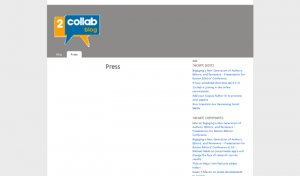
Not a lot of buzz here.
Interestingly, the product manager for 2collab Michael Habib:
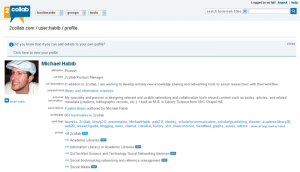
… clearly does get social networking in the sciences being active on FriendFeed:
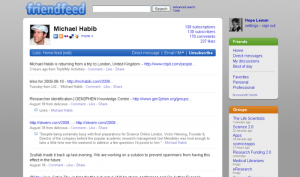
… and Twitter:
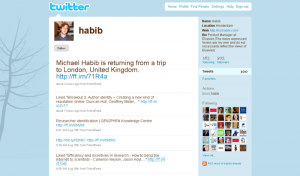
Yet his know — how in the world of Science 2.0 just doesn’t see to be enlivening 2collab. But admittedly, it is a tall order to try to combine the free and open world of Science 2.0 with the toll access world of Elsevier.
So let is take a look at what is in fact free on 2collab.
After a few clicks, I figured out how to display groups alphabetically. Not too excited by the first page:
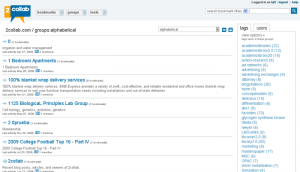
On a site designed for researchers, I am immediately put off by junky stuff about college football.
On the plus side, I clicked on the tab for discussions about 2collab itself and was taken quite seamlessly to this nicely formatted page:
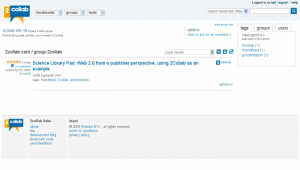
And could tell who had posted it — in this case our friend Michael Habib himself and what else he had bookmarked:
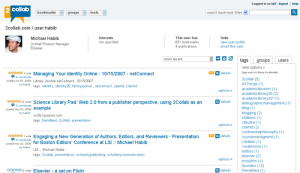
And returning to the page giving the link I was interested in I was wafted to a very useful discussion of 2collab and related services.
That is all very nice. But do I need the framework of 2collab to find such items? After all, there is Google and other search engines. And Twitter is getting ever better at search for tweets that lead to blog posts.
But part of the selling point of 2collab is its utility and value to serious researchers. So let us examine it from that standpoint.
Here we run to Web site design problems. I wanted to examine 2collab had to offer on the subject of neurology and neuroscience. I was able to get it to display groups alphabetically and to choose 100 items per page. But I couldn’t get a simple a-z listing. Instead, I got the annoying number of pages thing:
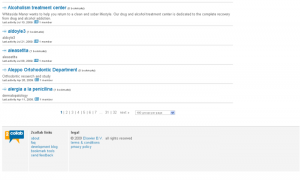
Grrr redux. How the devil am I supposed to know on what page neurology and neuroscience are to be found? Oh jeez, guess I have to guess and try page 15 as a start. Oh, rats — that won’t work, as I can go only by smallish increments and so have to click on 7 and work my way up to where neurology and neuroscience probably are, as 7 gets me only to C. This kind of poor Web design execution ill behooves an information powerhouse like Elsevier.
I tried page 10 — took me up only to E.
I finally figured out that I could search via a search box dropdown by subject of group — but there does not seem to be a group for neurology or neuroscience as broad subject areas, but only for subjects only tenuously connected to the subject of my search:
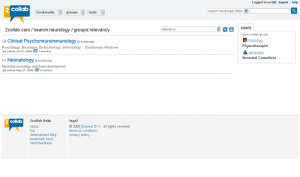
And each of those groups has only one member.
I decided to try to find a group for my main interest, amyotrophic lateral sclerosis. No results for groups. Decided to try “search bookmark titles.” No results. Well, knowing that amyotrophic lateral sclerosis is also called Lou Gehrig’s, I tried that. No results. Knowing that ALS is a form of motor neuron disease I tried “motor neuron.” That gave a single result and it was an abstract in PubMed — and why not just do your search in PubMed in the first place?
The search engine is dismally limited.
2collab does enable users to email other members, via 2collab’s mediation. But GoPubMed does that and so does LinkedIn.
And there isn’t much going on here compared to the pretty extensive use of Web 2.0 bells and whistles of BioCrowd. There doesn’t seem much buzz in librarian circles about 2collab and not much use of talk of it in Science 2.0 realm. Except for it the potential integration it with Elsevier’s other offerings, 2collab is basically a blah social bookmarking tool. If any major researchers or institutions are using it, you sure could not tell from clicking around in it.
To be fair, at least Elsevier is trying to get into Science 2.0 by launching initiatives like this. It’s not inexpensive to design, engineer and host these things. But traction is not evident for this one. In this case, market research was asleep. I can see the need for the quite exciting Elsevier product SciVal Funding. However, 2collab is a case of building it without determining why they would come or how to persuade them to.
Are you a Twitter user? Tweet this!


Nice post, Hope! My impression was more hopeful when I reviewed it after it launched, but sadly it doesn’t seem to have gone anywhere since. The major value of the service is its tie-in with ScienceDirect, and it had the potential to really leverage that, but it just doesn’t look like it has gone beyond being just a me-too social bookmarking product.
In fact, both Connotea and 2collab, have been foundering a bit relative to citeulike. Perhaps it’s not surprising that Citeulike is doing better, though. Would an independent project like citeulike necessarily have more energy and commitment than a side project like Connotea and 2collab? Is it a case of 100% commitment of fewer resources relative to 1% commitment of far greater resources or is it just harder to fight off the “what’s your business model” questions when it’s an internal project of a larger company? Maybe it’s something else entirely.
What follows is pure speculation, but …
I have a theory that independent projects start out with more goodwill than products coming from an established brand. There’s always a question of what will happen to the time you’ve invested in a service and the data you’ve accumulated. I think people trust a smaller outfit more because a smaller outfit is more responsive to and more dependent on its users, so they’re less likely to do something bad, and if they do, the users have the power to punish them more effectively than an established brand, which might just shrug off the complaints and can the project. Microsoft and Sony have been guilty of gross misconduct and disregard of their users and have largely gone unpunished for their behavior, whereas a smaller company wouldn’t have. Even Facebook, which is now a big company, had to cave to its users over the Beacon incident.
Imagine a board meeting where people are talking about what possible opportunities exist in Web 2.0. Part of the pitch for developing a competitive product goes like this: “We’re a well-recognized name and we’ve been around for a long time. Clearly we’ve got a marketing advantage over some fly-by-night independent project.”
Now imagine that someone stands up in the meeting, attended by their boss and people from the marketing department, and says, “Maybe our brand isn’t as well-loved as we think it is. Perhaps if we didn’t strongly brand this, the product would do better?”
I could be totally off the mark with this, and certainly resource allocation is part of the reason 2collab isn’t growing as strongly as it could have, but I also think they didn’t realize how important it was to gain the trust of the early adopters and to put a responsive and accountable public face on the project.
Hi, Bill. Thanks for your note below. Sorry to be slow to be getting round to responding to it. I was in transit to Toronto where I am now am attending Medicine 2.0:
http://www.medicine20congress.com/ocs/index.php/med/med2009
I agree with you about 2collab being just a me-too social bookmarking product. Strange that Elsevier didn’t look at Nature Precedings and not see how pretty useless 2collab is by comparison. And interesting that ResearchGATE
seems to working on a me too of Nature Precedings except that ResearchGATE’s
service (as I understand it) is for published articles and not pre-prints
http://blog.researchgate.net/index.php?/archives/98-Self-Archiving-Repository-goes-online.html
ResearchGATE has a rather vainglorious view of itself vis-à-vis inflated claims of firsts. It says, “We have now launched our Self-Archiving Repository! This project makes full-text articles available to the public, for free – the first application of its kind worldwide.
Currently, there is no way for researchers to access millions of publications in their full version online. We are now changing this by enabling users to upload their published research directly to their profile pages (a system called the “green route” to Open Access).”
That is all balderdash and bogus beyond belief. There are probably dozens of institutional repositories throughout the world at universities and other academic and research institutions. Some scholars have their own personal sites and there is the little matter of PubMed Central. ResearchGATE seems to have a genius for ignoring the efforts of academic librarians and the entire National Library of Medicine. Not the way to win friends in the information science and medical library worlds.
Thanks so much for the disquisition on Connotea, “…foundering a bit relative to CiteULike.” I had not heard that.
Apropos of your comments, “Microsoft and Sony have been guilty of gross misconduct and disregard of their users and have largely gone unpunished for their behavior, whereas a smaller company wouldn’t have,” here is a somewhat comparable instance of bullyboy tactics, this time by Google:
http://www.consumerwatchdog.org/corporateering/articles/?storyId=25100
Creepy that Google tried to get a tiny outfit’s grants pulled.
I actually would probably go with a well known name when it came to archiving given that it would be a huge headache if a company went under—which, for instance, the well funded Nature Publishing Group of Nature Precedings is far less likely to do than is the fall smaller ResearchGATE. I would probably go with the revenue-rich Elsevier, but there is nothing much to upload to in 2collab. And then, of course, big names can go under overnight as we saw last year in the world of finance. Scary times in so many respects, huh?
[...] « Previous article 2collab: Basic Blah Social Bookmarking Next article [...]
[...] might SciVal Funding fit in with Elsevier’s foray into social networking the sciences, i.e. 2collab? Will there be a way, for instance, for users to determine where potential collaborators might be [...]
[...] I have looked at smaller Science 2.0 sites, such as LabRoots, Scientist Solutions and 2collab, and it is at once clear that NPG is pouring money and talent into Nature Networks. Elsevier may be [...]
Hi Hope,
First off, thanks for taking the time to write such a detailed review. Sorry to be a little late in my reply, but I was on holiday when this article was published. I would like to take a minute to respond to some of your points.
* 2collab is a social reference management and bookmarking tool. As such, it is roughly in the same space as Connotea and CiteULike. Some of the unique features we have tried to include are:
* More robust group functionalities. As you noted there are a number of public groups that are spam. However, we have seen that there is very limited interest in public groups. The vast majority of interest is in private groups. Researchers are wary to share their current work for fear their competitors will steal their ideas. Our private groups are where more of the interesting collaborations are happening.
* As you mentioned, one of our main advantages comes from integration with other Elsevier products, such as Scopus and ScienceDirect. We had integrated 2collab into ScienceDirect. Any ScienceDirect item bookmarked in 2collab would show up in a box in the sidebar of the article page in ScienceDirect. This box showed number of times bookmarked, comment count, and rating. Unfortunately, we have had to temporarily turn this box off, while we work to improve the performance of 2collab. Worth noting is that this is the first step in determining how best to integrate with related tools such as Mendeley or CiteULike.
* Scopus is integrated in a number of ways. If an article is bookmarked that has a DOI, Scopus is checked and used to pre-populate and clean the reference information. Additionally, bookmarks with a DOI display their citation count from Scopus.
* Scopus Author Profiles are integrated into 2collab user profiles. A user can enter their Scopus Author Profile ID and import their publication list to 2collab. These articles will display as part of one’s profile on 2collab. Additionally, any bookmark can be marked as Authored by the user and will be added to their profile.
* As I mentioned above, a lot of the value of 2collab comes from it being used as a place to experiment with features that could later be added to other Elsevier products. It is our hope to take the best from 2collab, refine, and reuse.
* On a side note, I would like to mention the Spam problems 2collab has been experiencing. It is a major problem that has also caused severe performance issues. Consequently, all our resources are currently devoted to performance improvements and spam prevention.
* This has prevented us from adding some key features that are still needed. One key feature at the top of our list is proper Search. The current search is querying the database rather than a Search index. Once performance and spam are in check this is a top priority.
Since Elsevier began developing 2collab, a lot has changed in the social media realm. We are working to revamp our strategy accordingly.
Best,
Michael
Just noticed the comment is still awaiting moderation… Copying below, but the format is lost: "Hi Hope, First off, thanks for taking the time to write such a detailed review. Sorry to be a little late in my reply, but I was on holiday when this article was published. I would like to take a minute to respond to some of your points. * 2collab is a social reference management and bookmarking tool. As such, it is roughly in the same space as Connotea and CiteULike. Some of the unique features we have tried to include are: * More robust group functionalities. As you noted there are a number of public groups that are spam. However, we have seen that there is very limited interest in public groups. The vast majority of interest is in private groups. Researchers are wary to share their current work for fear their competitors will steal their ideas. Our private groups are where more of the interesting collaborations are happening. * As you mentioned, one of our main advantages comes from integration with other Elsevier products,…
This comment was originally posted on FriendFeed
Just noticed the comment is still awaiting moderation… Copying here: Hi Hope, First off, thanks for taking the time to write such a detailed review. Sorry to be a little late in my reply, but I was on holiday when this article was published. I would like to take a minute to respond to some of your points. * 2collab is a social reference management and bookmarking tool. As such, it is roughly in the same space as Connotea and CiteULike. Some of the unique features we have tried to include are: * More robust group functionalities. As you noted there are a number of public groups that are spam. However, we have seen that there is very limited interest in public groups. The vast majority of interest is in private groups. Researchers are wary to share their current work for fear their competitors will steal their ideas. Our private groups are where more of the interesting collaborations are happening. * As you mentioned, one of our main advantages comes from integration with other Elsevier products, such as Scopus and…
This comment was originally posted on FriendFeed
Hi, Michael. Thank you for your courteous and detailed response to my post on Next Generation Science about 2Collab. What you write is all very edifying. Good for you for being so responsive to comments about it and for being candid about various problems. Glad to hear that site search is a top priority. Hang in there—good for Elsevier for trying new things. Hope Leman
This comment was originally posted on FriendFeed
Hi, Michael. Thank you so much for your courteous, edifying note. Thank you for making clear exactly what 2Collab is. I appreciate your candor about the spam problems.
Apropos of your comment, “However, we have seen that there is very limited interest in public groups. The vast majority of interest is in private groups. Researchers are wary to share their current work for fear their competitors will steal their ideas. Our private groups are where more of the interesting collaborations are happening” there was an recent, interesting example of FriendFeed of a successful, open collaboration in that environment. See here:
http://friendfeed.com/yokofakun/11ee2366/gene-wiki-community-intelligence-applied-to
I guess we will just have to revisit the private group/public group matter two or three years down the road to see which model wins out.
Good for you for being open to integrating 2Collab with non-Elsevier tools. Such openness will benefit Elsevier in the long run given that the more integration there is across the Web there is, the better.
Good for you for working on the search matter. I am glad to see that Elsevier is working with NextBio in such areas, at least with ScienceDirect:
http://trainingdesk.elsevier.com/node/397
Hang in there! Elsevier is a content supremo and we support your efforts to render it discoverable.