by Hope Leman on Tuesday, January 27, 2009
I am only just entering the world of social networking in the sciences and learning my way (as we all are, really) around Science 2.0. Scientist Solutions is, to my way of thinking, an interesting example of the power of free.
Here’s how I discovered Scientist Solutions:
I help edit the free health sciences grants and scholarship listing service, ScanGrants. Periodically, I Google the term “ScanGrants” in the hope of discovering that it has been added to the database listings of yet another medical or academic library, or office of research administration at a university somewhere.
While doing this one night, I came across a link to ScanGrants in Scientist Solutions. A member of Scientist Solutions had linked to “Request for Applications: Basic & Clinical Research in Autism,” which was a grant announcement I had found at the site of the foundation, Autism Speaks. I was pleased — here was an example of a scientist alerting his peers to a grant opportunity that I had myself found in much the same way — by surfing the Web and sharing what I found.
This is classic Web 2.0. That is to say, carrying on conversation and decentralized control of information flow. These technologies enable researchers who may not have access to expensive proprietary funding databases such as Community of Science to learn about grants. By spreading around news of funding opportunities, it also increases the likelihood that foundations will be able to draw upon a larger pool of qualified applicants.

With online communities, it is often difficult to determine who’s running the show. Case in point: the About Us details of Scientist Solutions are sketchy. There isn’t any in depth information on the management team. I had to do quite a bit of digging to determine (via a LinkedIn profile) that the president of Scientist Solutions is Joseph “Rusty” Bishop, that he is a research scientist at University of California, San Diego, that his goal is, “To facilitate communication between bench scientists and life science manufacturers to speed the process of scientific discovery” and that his specialty is, “… bridging entrepreneurship and bench science.” Given the impressive list of sponsors of Scientist Solutions, I would say he’s pretty good at that.
I wanted to see in what category the link to ScanGrants had been placed in. I found the category, Funding Available and was able to set up an email alert. Indeed, it was so easy that it was set up before I had fully decided to go that far. There is also good RSS functionality.
Joseph Bishop posted a rather useful item about a lifesciences grant from Corning. But when I tried to view details about Mr. Bishop, there was hardly any information. The same holds true with the other members of Scientist Solutions. Given that one driving aims of Science 2.0 is interconnectedness and social solidarity, the paucity of detail about each member is a problem. I have just popped over to Nature Network and was able to click on the picture of various bloggers and moderators and get very detailed profiles. For example, Maxine Clarke’s profile provides a good deal of information: “I am an editor at Nature, the scientific journal. I also run Nature Publishing Group’s authors’ and reviewers’ website, Nautilus (the blog for authors), Peer to Peer (the blog about peer review) and a Nature Network blog archiving my From the Blogosphere weekly column in Nature. I am one of the editors answering Network users’ questions on the Ask The Editor forum.”
There is potential with Scientist Solutions. Those in research administration and headhunters in pharma might be interested in a firm advertising on the funding page, NaviGRANT, whose website offers an inside look at the ferocious world of grants in the sciences and an intriguing look at the skullduggery and stealth and poaching that goes on in certain fields in need of the best and brightest.
It is interesting to compare Scientist Solutions with LabRoots.
LabRoots has a much slicker interface and to me, the key advantage of a slick screencast. Gotta have one of those! Scientists are busy people and social networking takes time rather than, in most instances, saving it. Screencasts can sell a potential user on a site.
The search engine on Scientist Solutions is mediocre and the site is pretty thin on many things the Web 2.0 generation expects: video clips, podcasts, etc. It is basically a discussion board and not terribly vibrant in that respect. For example, the funding page is posted to only sporadically and it is not easy to determine what fora topics there are. The audience seems most interested in the nuts and bolts of lab work, as opposed to the deep think pieces on the Nature Network.
But more power to entrepreneurs in Science 2.0. Anyone who can line up sponsors in this miserable economic climate as Mr. Bishop has done is one skillful guy. I was particularly impressed that within a few minutes of my comment on his post about the Corning lifescience grant I received a private message from him about my comment. That is a pretty impressive level of involvement from the head of site to a new user. It is heartening that there are entrepreneurs working to render science a real-time endeavor and not one mired in the antiquated world of science dominated by the timetables of tenure committees and academic publishers. Keep up the good work, Mr. Bishop.
Tags:
community,
discussion board,
entrepreneurs,
forums,
lab work,
science 2.0,
Scientist Solutions
Technorati Tags: community, discussion board, entrepreneurs, forums, lab work, science 2.0, Scientist Solutions
 Like this article?
Next Generation Science delivers weekly articles on emerging technologies and tomorrow's science. Join the community by
subscribing (more).
by Walter Jessen on Friday, January 23, 2009
Science 2.0 leverages a variety of Internet technologies, including RSS, blogs and folksonomies (tagging), to promote conversation and make it easier for researchers to connect, communicate and collaborate. A model Science 2.0 website that incorporates all these technologies is ResearchBlogging.org.
ResearchBlogging.org is an organization that strives to identify serious academic blog posts about peer-reviewed research. It is a self-enrolled, quality standards program created by Dave Munger, who writes for the psychology blog Cognitive Daily. ResearchBlogging.org aggregates blog posts from around the Web discussing peer-reviewed scientific research.
Today, reports of scientific research in the mainstream media are frequently the product of a public relations office. The problem with “science by press release” is that it’s often selectively focused on those results that have huge impact or stir controversy. ResearchBlogging.org provides an alternative source for reporting of scientific research, relying on scientists instead of press officers to define, describe and analyze published research studies.

Dave Munger (left) and Research Blogging advisory team member Eric Schnell (right) following a presentation of ResearchBlogging.org at the NISO Discovery Tools forum (a conference for librarians interested in Web 2.0 technologies).
I had the opportunity to interview Dave Munger recently and find out more about ResearchBlogging.org and their approach to the organization and dissemination of serious peer-reviewed scientific research.
The Interview
Dave Munger, thanks for taking the time to talk with me. Tell me a little about yourself.
I’m a writer who’s also a former science teacher and textbook editor, so I’m very concerned about how information, scientific and otherwise, gets distributed (or not distributed). Greta Munger, my co-blogger on Cognitive Daily, is the real scientist, a psychology professor at Davidson College who identifies the research we write about and makes sure whatever we do publish on our site is accurate and high-quality.
What is ResearchBlogging.org and why did you create it?
A few years ago we developed an icon for Cognitive Daily to indicate when we were blogging about a peer-reviewed research, rather than just linking to a mainstream media news article or another blog post. Another blogger, Sister Edith Bogue, a sociology professor who also blogs about religion and faith, asked us if she could use our icon on her blog. Since our icon was customized to go with our own site design, we didn’t think that was a good idea, but then Sister Edith came up with the key suggestion that led to ResearchBlogging.org: Wouldn’t it be great if there was an icon that anyone could use to identify their serious posts about peer-reviewed research, as opposed to more hastily-written or personal posts?
It wasn’t a very large leap from that to the idea of a central site collecting all of those posts from across the internet. We created a new blog to discuss the concept, and within a few months a student volunteer had created what became the prototype for the current site. Soon hundreds of bloggers were using the site, and our new site, developed in collaboration with Seed Media Group, has collected over 3,000 high-quality blog posts on subjects ranging from anthropology to zoology.
Can you describe the guidelines a blog has to meet to become a member and publish under the Research Blogging icon?
For each language we support, we have three moderators from a range of disciplines. Users apply to join our site, and a moderator visits their blog to make sure they meet our requirements. Blogs must have at least one post about peer-reviewed research to join, and when they discuss research, they must do so primarily using their own words. Just quoting an abstract or reposting a figure doesn’t cut it.
After a blog joins, our readers can flag any post they believe doesn’t meet our standards, and it will be removed from the site if it doesn’t follow our guidelines.
How popular is ResearchBlogging.org?
That’s a little difficult to assess. We have over 30 different RSS feeds and a variety of other ways of connecting directly to our members’ posts without visiting our site, so just the traffic on our main site (about 1,000 visits per day) may not be an accurate representation of how popular we are. Our participating bloggers say they get a nice boost in traffic when a post appears on our ResearchBlogging.org. One way we are now reaching even more potential readers is through a widget which appears on ScienceBlogs. This widget places relevant headlines in front of hundreds of thousands of visitors. Soon we’ll have a version of the widget that can be placed on anyone’s blog, potentially reaching hundreds of thousands more. We’re also starting to build a presence on Twitter and other social networking sites.
ResearchBlogging.org is similar to the Health On the Net (HON) Foundation, which promotes and guides the growing online community of healthcare providers and consumers to reliable health information and expertise through quality assessment and stringent peer review. How does ResearchBlogging.org assess blog quality and/or author expertise for inclusion? Is there a mechanism for reviewing participating blogs?
As I mentioned before, a moderator visits each blog before it is allowed to join the site. If a moderator doesn’t feel he has enough expertise to assess the blog’s content, he’ll share it with other moderators or consult experts in the blog’s specialty field. We also reserve the option of removing a blog from our site if it doesn’t meet our standards. But overall, we’ve found that bloggers themselves have set a very high standard, and nearly every post on our site is top-quality, typically offering much more detailed discussion than you would find in a mainstream media report about the same research.
What do you see as the difference between HON and ResearchBlogging.org?
HON attempts to be an encyclopedic medical reference, while ResearchBlogging.org offers general discussion about cutting-edge research. Our site is a great way to follow current trends in one or more fields, to read thoughtful posts and find interesting discussion about research, and find out if a particular journal article has been discussed in the blogosphere. HON is more comprehensive, but covers a narrower range of fields [focusing only on health and medical information].
How does ResearchBlogging.org manage blogs that are promoting and/or reviewing pseudoscience?
We don’t allow them on our site, and we don’t allow them to use our icon even if they haven’t registered. We had one high-profile case of an “Intelligent Design” blog using our icon without registering for the site and we had an open, public debate about whether this use should be allowed. The blogger removed the icon from his blog and he wasn’t allowed to register. We’ve had several other cases that were handled internally with similar results. We are committed to disseminating only accurate, thoughtful discussion of peer-reviewed work.
Are there any changes coming to ResearchBlogging.org? Can you let us in on anything new to watch for in the near future?
Right now we are primarily focused on broadening our site’s reach. We have over 500 registered blogs, representing over 3,000 blog posts in English and German. We will gradually add new languages while ensuring that the quality of the posts is equivalent, no matter the language they are written in (users have the option of specifying which languages they see when they visit the site). We’re also working on adding new features to the site — we have a long wish list, including more automation in citation-generation, more integration between our forums and main site, and more connections with other resources such as journal and library websites. Ultimately we hope that any time a person does a library search for a journal article, they will not only find the article itself, but also links to all the blog posts discussing that article.
As more and more scientists use Web 2.0 technologies, what do you see in the future for ResearchBlogging.org?
I see scientists taking more responsibility for disseminating the results of their work to the public, relying less on the media to interpret their results for them. Eventually every lab will have a blog that discusses not only the research coming out of their own lab, but also other relevant research from around the world. ResearchBlogging.org can be a hub connecting all those discussions, bringing researchers together and sharing that research with interested members of the lay public.
Tags:
blog,
peer review,
ResearchBlogging.org,
RSS,
science 2.0,
Science Research,
tagging
Technorati Tags: blog, peer review, ResearchBlogging.org, RSS, science 2.0, Science Research, tagging
Like this article? Next Generation Science delivers weekly articles on emerging technologies and tomorrow's science. Join the community by
subscribing (more).
by Hope Leman on Wednesday, January 21, 2009
LabRoots is worth a look for those interested in social networking in the sciences. It is far better and more active than ResearchGATE.
Here’s how LabRoots defines itself: “LabRoots is a free, social networking site that enables scientists, engineers, and other technical professionals to connect, collaborate with, and learn from each other.”
One thing I found questionable was the rather free and easy use of the term, “… experts in that field.” For instance, we are told that “Each discipline or focus area of the LabRoots site is moderated by experts in that field. These moderators come from all over the world and more than 90% of them have PhDs.”
Now read the profile of one of the moderators:
“Michael Downey B.S., Michael is currently in his second year at the University of Virginia. He is pursuing a double major in Anthropology and Environmental Thought and Practice, as well as a minor in Environmental Science …”
Thus, Mr. Downey appears to have one bachelor’s degree and is now again an undergraduate. He may be a capable, brilliant young man, but he is nevertheless an undergraduate. I don’t think, except in the rarest of circumstances, that most scientists would accept the characterization of undergrads as experts in a field save perhaps software development or something comparably technical. That may be unfair, but it is nevertheless the case. “Expert” connotes gravitas and undergrads don’t exude that, as a rule.
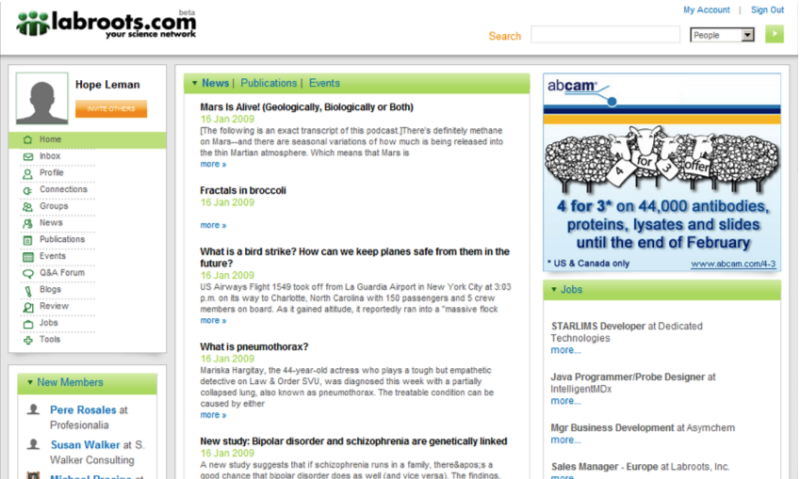
Also, it is not a promising sign of the vitality and sustainability of a social networking site if most of the comments are provided by people somehow connected with the community in an official capacity. For instance, in the Q&A Forum on the quite interesting question, “Medical Research for 2009 — What’s Hottest?” there are five responses; two of them are by me as an experiment on my part. The fact that I inadvertently entered the same response twice shows that there are user-friendliness problems in the commenting section of LabRoots. All of the other answers have been provided by moderators (which is not necessarily a bad thing given that it demonstrates some interest by the proprietors and volunteer or paid staff of a social community in the goings-on in their own fora), save one by the President of LabRoots, Greg Cruikshank.
I checked out Mr. Cruikshank’s own page and wanted to read the article he listed on social networking in the sciences. But I received an error on that one. Not so good if there are quality control problems and link rot on the President’s profile page.
It was often unclear to me how things worked on the site. Take the “Publications” pages for example. It was not clear what the criteria were for inclusion and the links, rather than enabling a user to download a PDF of the paper in question (which is how I interpreted the wording “Click here for complete publication …”), in most cases took me either to PubMed or the toll access page of the article publisher. The Publications feature definitely needs overhauling.
My biggest wish is an alphabetical list of the groups. You can search by discipline but not alphabetically. The Clinical/Health/Medicine category has 10 groups, the largest of which in terms of membership is Molecular Diagnostics with 24 Members. Many groups have one to four members.
One wonders if Science 2.0 can be run on a for-profit basis (though the commercially-run Sermo seems to be making a go of it for physicians in mainstream medicine patient care matters) or whether it can be sustained only by volunteer models, a la Wikipedia. It is hard to see companies such as this making it. There just isn’t much oomph here or anything that sends the blood racing and the brain a buzz. I poked around for purposes of this article, but other than that not much going on here. Good effort, though. Scientists do need to talk to each other. But they probably need to do so via their own professional organizations and in an organic fashion, not within frameworks that work better for patient communities than for serious scientists.
Tags:
community,
forums,
groups,
science 2.0,
Science Social Networks
Technorati Tags: community, forums, groups, science 2.0, Science Social Networks
Like this article? Next Generation Science delivers weekly articles on emerging technologies and tomorrow's science. Join the community by
subscribing (more).
 Share on Facebook
 Add to Connotea
 Stumble it
 Add to Delicious


 Loading ...





